Demons Believe?
November 11, 2026 at 10:48 AM Leave a comment
But someone will say, “You have faith, and I have works.” Show me your faith without your works, and I will show you my faith by my works. You believe that there is one God. You do well. Even the demons believe—and tremble! (James 2:18-19)
 This is an interesting couple of verses from the book of James. It is astounding to me how various commentators will break these two verses down and arrive to concrete conclusions about them. I also think it is interesting that we are told that demons themselves believe that there is one God and even tremble because of it!
James (or an objector), is comparing faith to works, or the person who says he/she has faith and does not have the works to back their faith up. In other words, they are all talk, with no discernible action/works on their part. I also find it fascinating that we read that demons “believe” that there is one God. Actually, don’t they know that there is one God? Doesn’t it go beyond belief for demons? After all, prior to Satan’s and their own fall away from God, they saw what He did and witnessed the relational aspect of the Father, the Son and the Holy Spirit. They saw His creativity in the days of Creation after they themselves were created by the same God they “believe” exists.
My point is that I’m not sure why James used the term “believe” when in point of fact, the demons actually know that there is one God, unless of course, the person is an objector to James and making that statement. The reason demons tremble is because they know their ultimate and eventual end of their own personal rebellion against their Creator. This is not up for debate. Their future assignment to the Lake of Fire is literally a done deal. It is very much like the eventual death of every human being (save those who are taken in the Rapture). At some point, every human being will die, leave this life and enter eternity. That is a done deal.
When demons met Jesus in numerous places in the Gospels, they were clearly terrified and knew He had absolute control over them and what was to happen to them. They knew who He was/is. None of this is debatable. It is pure fact. There is nothing to “believe” about this and demons don’t believe this. They know it to be true.
So, why does the text state that demons “believe” there is one God when in point of fact, they absolutely, without doubt know there is one God? Of course, biblical scholars disagree and depending upon whether or not they are Reformed, Calvinist, Arminian or Free Grace, the answers given flow from a particular biblical lens. Some within Lordship Salvation (LS), might argue that this “belief” from demons is nothing more than “intellectual assent” (as a pejorative). The problem is that for the demons, it is more than intellectual assent. It is actually knowledge about who God is. Their knowing about God does not change the fact that they are irredeemable as far as salvation is concerned. They fully understand their final fate because of their rebellion and the fact that there is no salvation for them.
Those on the Reformed side of things posit that the text argues against a position of intellectual assent to receive salvation. They state that even though demons mentally understand that there is one God, that understanding does not translate to actual saving knowledge where God is concerned. Demons do not fall under God’s salvific message. It is not addressed to them and only concerns them indirectly with respect to where they will spend eternity because of Jesus’ victory over sin and His redemption of humanity (those who come to Him in faith believing that He is who He said He is and did what He did on our behalf). Nowhere are demons (or Satan for that matter), included in the possibility of redemption.
Many within Free Grace argue that to receive salvation, simple intellectual assent is the basis. No commitment to promise to follow Jesus every step of the way is required. Certainly, Free Grace understands and teaches that good works should follow a person’s receipt of salvation, but no works at all are needed to receive salvation except the “work” of faith and the works that are done in His strength following receipt of salvation do nothing to “earn” or “keep” salvation, which cannot be lost. I think for some people, it may simply seem like intellectual assent as their mind is changed regarding Jesus; who He is and what He accomplished for them. Others may be more deeply affected emotionally because of their new understanding of who Jesus is and what He accomplished for them and just exactly what He saved them from.
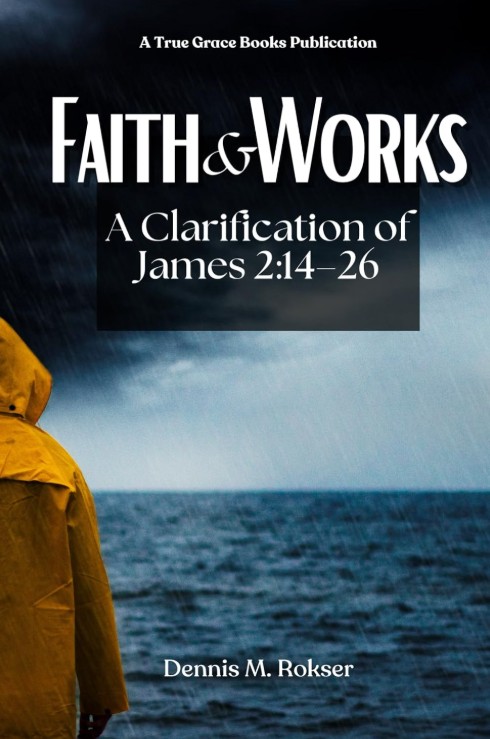
The reason I included the image of the cover of Dennis Rokser’s book, Faith & Works, A Clarification of James 2:14-26, is due to the fact that Rokser offers incite regarding the overall position of the book of James, specifically with respect to James 2:14-26, which includes the text in question presented at the opening of this article. Rokser actually builds a plausibly potent argument for the fact that he believes the “salvation” being referred to in James 2 is not our spiritual salvation, but our temporal salvation, if you will. In other words, James is clearly writing to believers, those who already possess salvation. If they already possess it, then James must be discussing something beyond salvation, which enters into the realm of our progressive sanctification and ultimately, rewards for the believer after this life is over. I encourage readers to buy the book, available on Amazon for $5.99, with a total of 37 pages. It’s a quick read, filled with deep truths. Rokser notes this about the epistle of James.
Nowhere in this epistle, do we see even one invitation for them to believe the Gospel of Christ and be eternally saved by grace alone through faith alone in Christ alone. Why? It is because they had already believed when they were born again (1:18)![1]
In James 1:2-4, James discusses the need to endure trials, joyfully. Why? Because enduring trials with joy produces patience and growth in the Christian’s life.
Trials would provide these believers a wonderful opportunity to learn not only to trust the Lord from day by day but also to love one another, as expressed through beneficial good works that would minister to the spiritual and physical needs of these suffering brethren. But this practical love and walk of faith would occur only if they were to hear the Word of God and apply it by faith to their daily lives. This train of thought and significant point are essential to grasp if you’re going to understand James 2:14-26 and many other passages in the book of James.[2]
We know that today, many people attend some type of church who may not be saved at all. In many circles, it’s simply the accepted thing to do today. During the first century, no one attended churches unless they were actually saved because persecution was very real. An unbeliever would not have joined in with Christians knowing that the chance of persecution would come for them. It is always helpful to understand the actual historical context of these epistles when they were first penned, as well as understanding the context of the text itself from the original Greek.
It should be no surprise that those within the Reformed (Lordship Salvation) camp use the text in James to buttress their contention that continued works are required in the life of the believer to prove the person is actually the beneficiary of salvation. But I do not believe James is saying that at all.
In reality, it appears the text in James is ultimately noting that it is impossible to see a person’s faith. We can see how they might interact with other people. They might be pleasant and/or have some type of charismatic (not signs and wonders) personality and because of that, people tend to be attracted to that person. However, in none of this can we actually see that person’s faith within them; what happens under the hood, so to speak. In fact, we must admit that many people who are atheists may be kind, consistent and even loving people, yet they obviously lack salvation. Judging a person by their words and actions, regarding their salvation, is not something we should be doing.
In the end though, this short passage from James 2 is filled with numerous exegetical problems as noted by many who have delved deeply into the original languages and manuscripts.[3] It simply is not an easy one to figure out though many within evangelicalism believe they have figured it out completely and say it is proof that persevering in good works is necessary in the life of the believer. There is actually at least some evidence that the objections spoken in the passage were not uttered by James himself, but by an objector. The problem with the Greek is that punctuation marks were not included to prove it because punctuation marks like quotation marks (“) are not included in the Greek. Had they been, it would have proved one way or another who was actually doing the talking.
Finally…the words of Jas 2:19 are not spoken by James himself. Instead, Jas 2:18-19 as a whole comes from the mouth of the imaginary objector introduced in 2:18a. It should be obvious that if this is the case, evangelicals will need to abandon the use of this verse to establish orthodox definitions of faith. Should we teach as truth that which comes from the mouth of an objector to the apostle James?[4]
Whether evangelicals will abandon their use of these two verses to define the orthodox view of faith is questionable, but will likely not happen. It reminds me of the same evangelicals who consistently use Revelation 3:20 as an invitation to the lost.
Behold, I stand at the door and knock. If anyone hears My voice and opens the door, I will come in to him and dine with him, and he with Me.
In that verse, Jesus is actually standing outside a church (Laodicea), knocking to be let in so that He can actually enjoy fellowship with the believers in that particular church. Sad that believers in Laodicea had fallen to the point of ignoring the very Person who provided salvation to them, isn’t it?
I wonder how many churches today fall into that same category? I’m not saying that the people of those churches may not be saved (although that can apply). I’m saying that the people in those churches are so preoccupied with worldly matters that they have literally lost sight of their first love and have pushed Him out. He wants back in so He politely stands outside the closed door and knocks, waiting to be invited back into fellowship with the believers there. Revelation 3:20 is an interesting passage and it ultimately speaks to believers who are out of fellowship with God in Christ. It does not speak to unbelievers.
I believe the main push of James is to believers, people who possess salvation and are in need of instruction regarding how they should love one another and God. James is not speaking to unbelievers because he never presents the Gospel message as if to those who need to hear it because they are not saved.
Those within evangelical circles need to stop using James 2:18-19 as an evangelization message to the lost. That is not what James is doing in his short epistle. He is helping actual believers know best how to live and relate to other brothers and sisters in the Lord. James is not providing insight into how to tell if someone is actually saved or not by the works they do or do not do. He is teaching believers what they should be doing and how they should be living in order to grow in their faith and have lives that are pleasing to God.
Ultimately, what James is talking about is the believer’s ongoing sanctification. They already possess salvation. James provides insight into how salvation is lived out.
[1] Dennis Rokser, Faith and Works, A Clarification of James 2:14-26, p10
[2] Ibid, p11
[3] https://faithalone.org/journal-articles/the-faith-of-demons/
[4] Ibid
Entry filed under: Atheism and religion, christianity, Demonic, eternity, Religious - Christian - Prophecy, Religious - Christian - Theology, salvation, sanctification.


Trackback this post | Subscribe to the comments via RSS Feed